System Integration and Cross-Border Impact
The EcoEnergyH2 project has been developed as a response to the growing need for a modern, stable and zero-emission energy infrastructure in the Szczecin Lagoon region and West Pomerania. Its primary objective is to leverage the regional potential of renewable energy sources and unique geological conditions to establish an integrated, cross-border energy hub connecting Poland, Germany and the European Union.
Despite the absence of clear long-term hydrogen strategies in both Poland and Germany, and the current uncertainty on the European hydrogen market, hydrogen is expected to play a significant role in the decarbonisation of the industrial and energy sectors. In this context, EcoEnergyH2 focuses on partners with strong purchasing power and investment capacity, such as Grupa Azoty Police, the PCK Schwedt refinery and international investors.
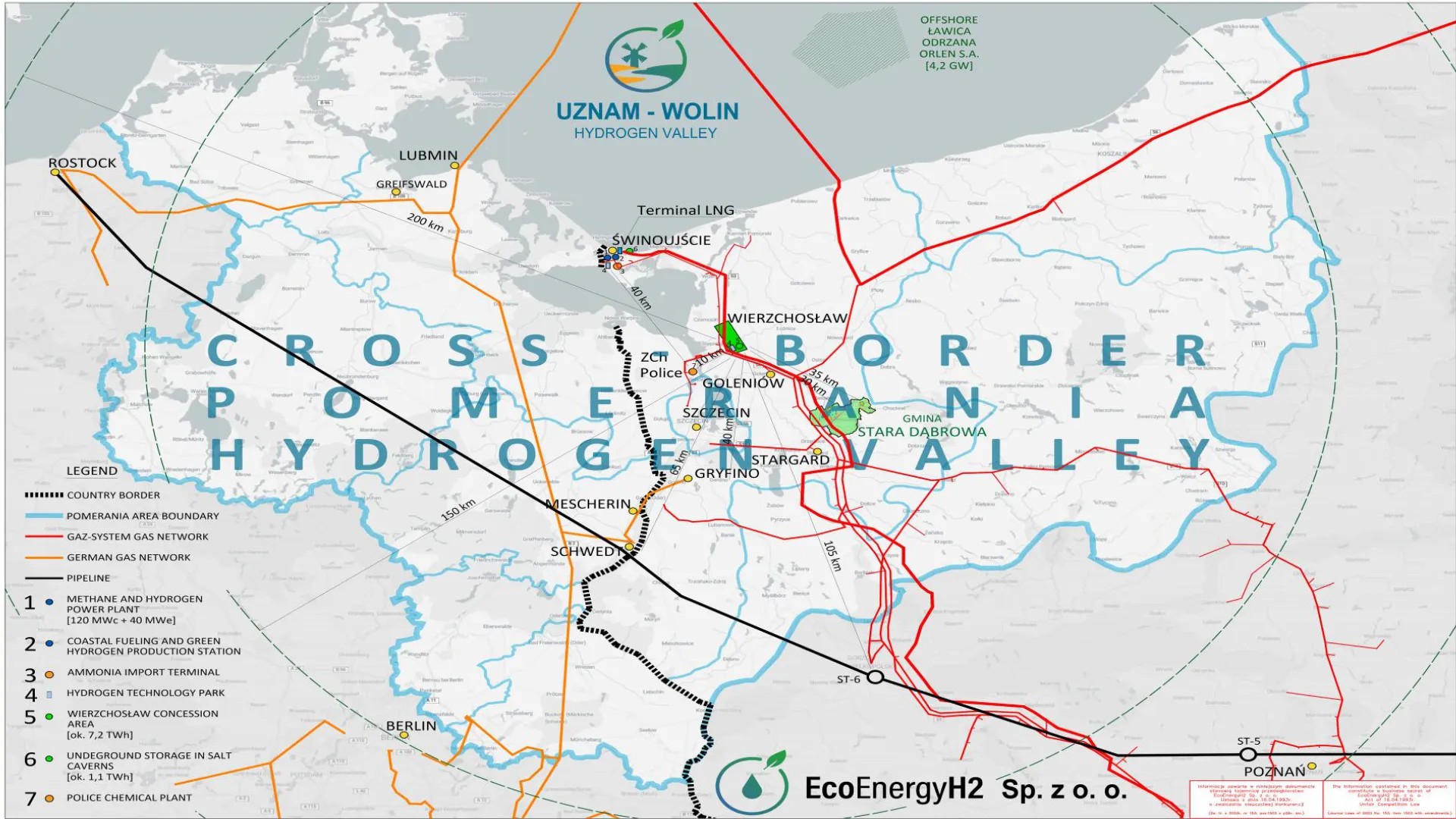
Since 2021, EcoEnergyH2 has been developing an innovative project involving the construction of large-scale underground storage caverns designed for hydrogen (H₂), natural gas, crude oil, ammonia (NH₃) and CO₂. The planned locations include the Świnoujście area and central West Pomerania. The project is intended to function as a regional and cross-border energy hub capable of producing, storing and managing renewable energy in coordination with the energy systems of Poland, Germany and the EU.
1/ Mining concessions and potential of the two main locations
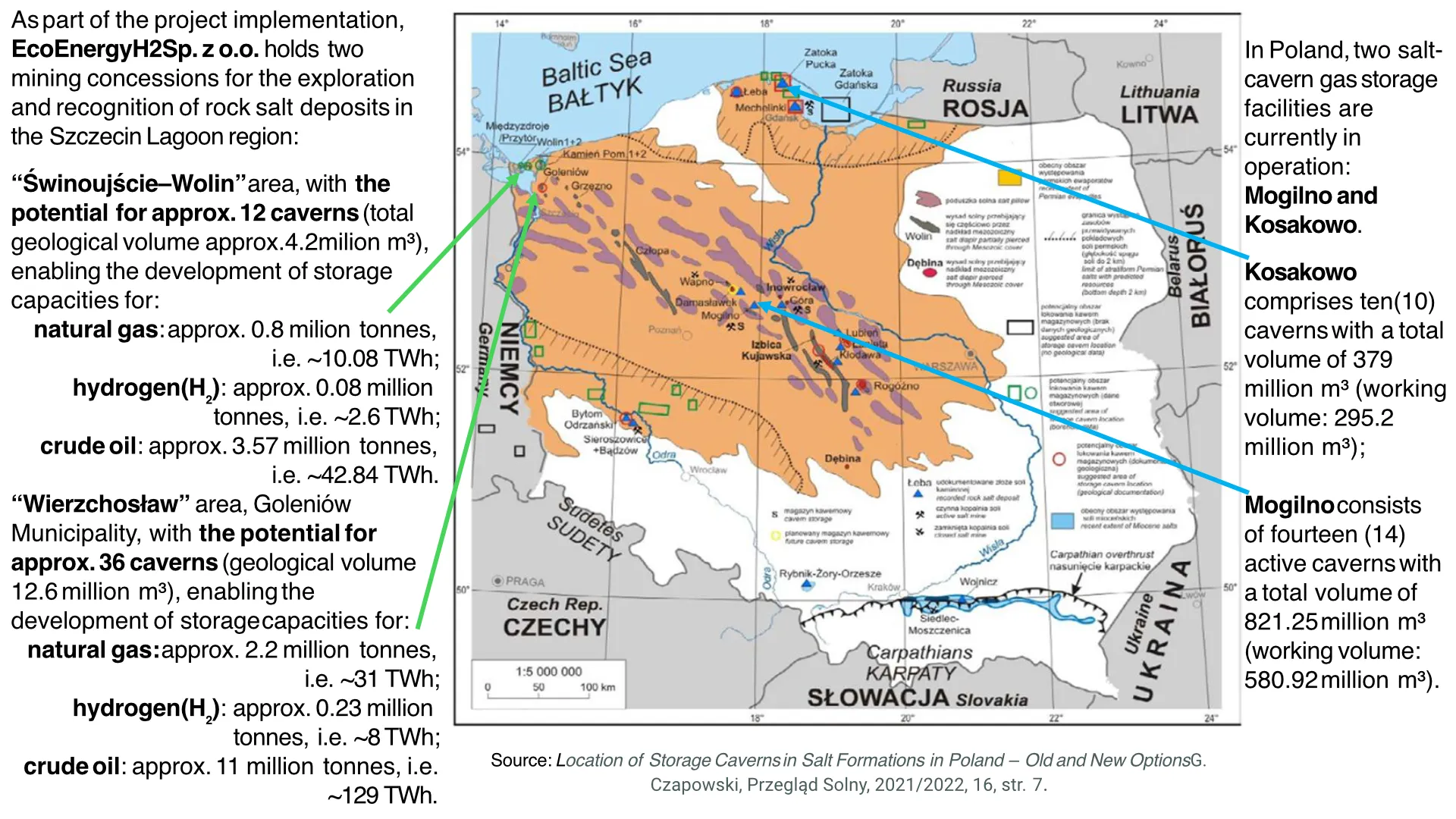
EcoEnergyH2 currently holds two mining concessions for the exploration and exploration of rock salt deposits (Ministry map with company concessions marked):
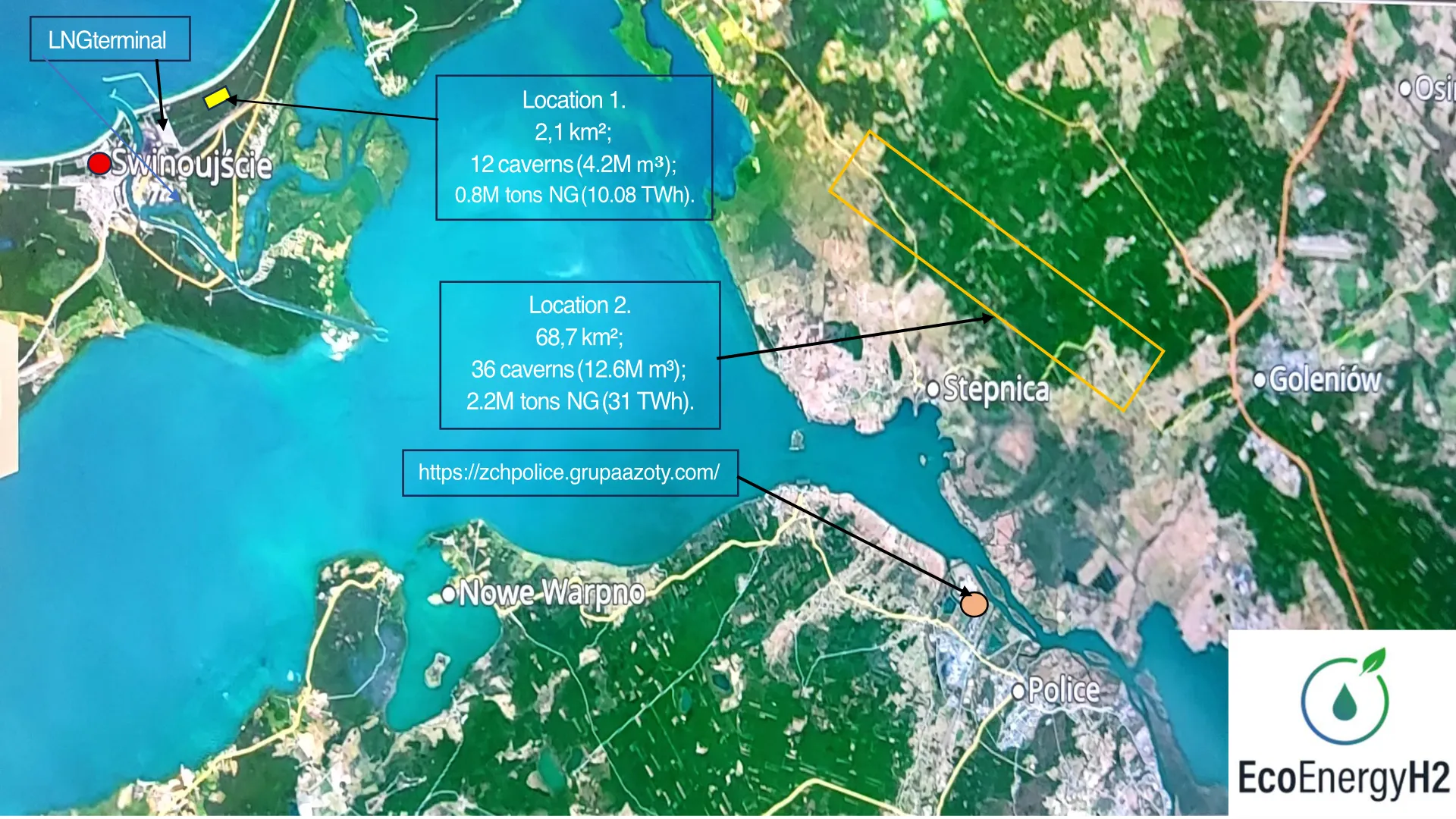
Location 1 – „Świnoujście–Wolin”, Świnoujście commune (Przytór)
- area: approx. 2.1 km²
- concession granted: 2022
- potential: approx. 12 caverns
- total geological volume: approx. 4.2 million m³
- storage potential:
- natural gas: ~0.8 million tons (10.08 TWh)
- hydrogen H₂: ~0.08 million tons (2.64 TWh)
- crude oil: ~3.57 million tons (42.84 TWh)
Location 2 – “Wierzchosław”, Municipalities of Goleniów–Stepnica–Przybiernów
- area: approx. 68.7 km²
- year of obtaining the license: 2025
- potential: approx. 36 caverns
- total geological volume: approx. 12.6 million m³
- storage potential:
- natural gas: ~2.2 million tonnes (31 TWh)
- hydrogen H₂: ~0.23 million tonnes (8 TWh)
- crude oil: ~11 million tonnes (129 TWh)
Key strengths of both locations
- exceptionally high volumetric and energy storage capacity (gas, H₂, oil, NH₃, CO₂)
- scalability up to 48 caverns (approx. 44 TWh of storage capacity)
- potential for production of approx. 200 tons of hydrogen per day from RES
- strategic location near:
- Grupa Azoty Police
- he LNG terminal in Świnoujście
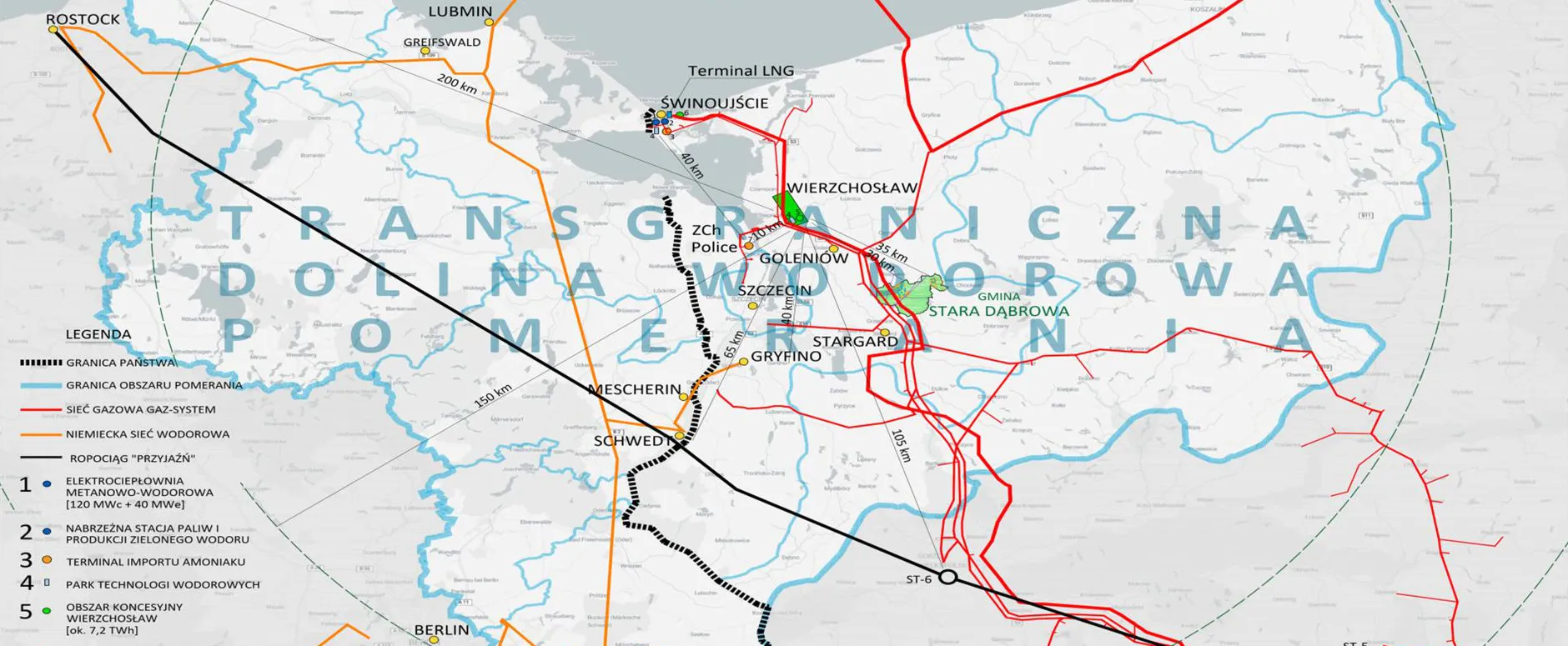
- cross-border infrastructure (PCK Schwedt, Rostock)
- national transmission networks (PSE, GAZ-SYSTEM, PERN)
2/ System synergy with regional and European energy infrastructure
The EEH2 project is designed for seamless integration with:
- the Polish power system (PSE)
- the national gas transmission system (GAZ-SYSTEM)
- the crude oil pipeline network (PERN)
- future European hydrogen corridors (European Hydrogen Backbone)
It can play a critical role in:
- balancing Baltic Sea offshore wind generation
- large-scale storage of renewable energy (H₂, gas, oil, NH₃, CO₂)
- strengthening strategic reserves
- stabilising the electricity grid through hydrogen production (P2G, P2X)
3/ Submission to PSE and integration with offshore energy
In April 2024, EcoEnergyH2 submitted the project to PSE within the Development Plan (PRSP 2025–2034).
The project provides capacity for:
- balancing up to 5 GW of power
- storing up to 44 TWh of renewable energy in hydrogen form
- integrating with offshore wind generation in the southwestern Baltic (e.g., 4.2 GW from the Ławica Odrzana OWF)
4/ Cross-border cooperation and the Hydrogen Map of Poland
In July 2024, the Company submitted proposed hydrogen project locations to GAZ-SYSTEM for inclusion in the Hydrogen Map of Poland. These locations, situated in the Uznam–Wolin Hydrogen Valley and the Szczecin Lagoon region, include future sites for:
The data submitted includes future locations:
- hydrogen production
- industrial consumption
- distribution
- storage
- cross-border transmission to Germany
5/ Environmental conditions and innovative pressure-based energy generation
The Wolin Island location (approx. 2.5 km from the coastline) offers:
- access to low-salinity seawater for cavern leaching
- environmentally safe discharge of brine into the Baltic Sea
- possibility to generate renewable electricity from pressure differentials (250–300 bar → 70–80 bar) using gas expanders
This creates a stable, local, and emission-free energy source that supports RES integration.
6/ European cross-border dimension
The EEH2 project enables:
- development of a regional energy hub linked with German and EU markets
- integration with future Poland–Germany hydrogen pipelines
- strengthening of secure cross-border energy corridors
- support for energy-intensive industries (Police, Schwedt, Rostock)
- long-term contribution to European energy security